Tuesday, 27 September 2011

Publishing & Editorial


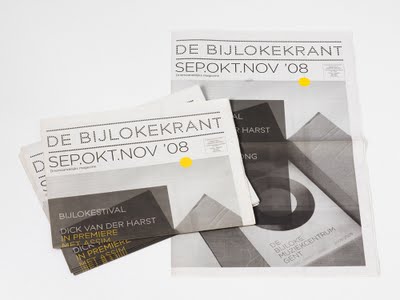
Base Design wanted to bring classical music to life when creating an identity for De Bijloke, a Belgium music centre. Base design turned something that’s not necessarily considered young and contemporary into something current and appealing. 

 I particularly like the use of vibrant yellow on the desaturated photograph as it sits well on the design.

Monday, 26 September 2011

Packaging & Promotion


This piece of packaging and promotion is effective as they've managed to create a certain character to the company. 

Branding & Identity

What is brand? – The perceived emotional corporate image as a whole.
What is identity? – The visual aspects that form part of the overall brand.
What is a logo? – A logo identifies a business in its simplest form via the use of a mark or icon.


When looking at the work on ‘September Industry’ I came across Moving Brand’s work for All About Tea. It’s a perfect example of taking something every day, such as tea, and turning into a desired and a sophisticated product. 

The logo has clearly been given thought as, although is simple, it’s appropriate to the given brief. Its effectiveness comes through simplicity. The chosen use of metallic for the packaging creates a sophisticated looking product. Finally the type used on the posters are contemporary and compliment the designs. Overall I feel it’s a successfully delivered brief.


  I came across this student's packaging for the Ilford 120 film. This piece of design directly relates to my chosen 'good' and so it's interesting to see how another student has handled it. It reintroduces and encourages the use of analog film technologies as a pinhole camera.


I really like Jack Crossing's vinyl work for Noir Blanc. I think it's the combination of the photographs/images with the triangular shaping that really appeals to me. All of the designs are crisp and visually engaging. The type fits in nicely with the finished look of the vinyls too and overall this work really inspires me. 

I find it really interesting looking at different identity briefs and how they mould and shape the individuals work. Jack Crossing seems to do this really well with this work. The final designs look expensive and sophisticated.


 I really like Anagrama’s designs for El Vivero, mainly because I feel it’s a piece of contemporary design that was intended to reflect the new, young audience of the business. With the chosen vibrant colouring and the simplistic layout, they have created a sophisticated and modern piece of graphic design which ofcourse is something I aim to achieve in my work. They wanted to keep the designs 'fresh' and I'd say it's definitely achieved with the combination of the layout, text and blank space. 


This is a distinctive new piece of brand identity by Golden. I really like the choice of stock for this piece of brand identity as not only is it appropriate but it denotes sophistication.

Monday, 18 April 2011

WHAT IS A LINE?

What is a contour line?


"A contour line (also isoline or isarithm) of a function of two variables is a curve along which the function has a constant value. In cartography, a contour line (often just called a "contour") joins points of equal elevation (height) above a given level, such as mean sea level. contour map is a map illustrated with contour lines, for example a topographic map, which thus shows valleys and hills, and the steepness of slopes. The contour interval of a contour map is the difference in elevation between successive contour lines"


A brief hostory:

"The idea of lines that join points of equal value was rediscovered several times. In 1701, Edmond Halley used such lines (isogons) on a chart of magnetic variation. The Dutch engineer Nicholas Cruquiusdrew the bed of the river Merwede with lines of equal depth (isobaths) at intervals of 1 fathom in 1727, and Philippe Buache used them at 10-fathom intervals on a chart of the English Channel that was prepared in 1737 and published in 1752. The use of such lines to describe a land surface (contour lines) was studied theoretically by Ducarla in 1771, and Charles Hutton used them when calculating the volume of a hill in 1777. In 1791, a map of France by J. L. Dupain-Triel used contour lines at 20-metre intervals, hachures, spot-heights and a vertical section. In 1801, the chief of the Corps of Engineers,Haxo, used contour lines at the larger scale of 1:500 on a plan of his projects"


Like with the tube maps, contours has become a world wide piece of visual communication. By simply using a line, people are able to understand the form of the earths surface.


here you can see the contours themselves have been placed over some form of birds eye image over a mountain....there's something quite interesting about this and it will probably be the main focus of some of my designs! :


An example of contours applied in design:

here line is used to dramatise the shape of the model...

it guides the eye around the body:


Thursday, 24 March 2011

WHAT IS A LINE?

Types of line:


line of trees


line of people


lines on the face


directional lines


border line


countour lines


line of music


the simple line of a pencil


Some examples of line being applied to create image:
Georgina Luck
 - Shows how the simple use of line can be effective when creating an image


------------------------------


David Bignotti
 - Line used for simple imagery/illustraion...


------------------------------


Robinsson Cravents
 - Minor lines used to build up to a larger image
 - No distinct outline to the image


------------------------------


Focusing on ancient math & shapes...


I wanted to focus on harmony and order within shapes. In order to do this, a brief history of math will probably aid my progress....

"Babylonian mathematics (also known as Assyro-Babylonian mathematics[1][2][3][4][5][6]) refers to any mathematics of the people of Mesopotamia, from the days of the early Sumerians to the fall of Babylon in 539 BC. Babylonian mathematical texts are plentiful and well edited.[7] In respect of time they fall in two distinct groups: one from the Old Babylonian period (1830-1531 BC), the other mainly Seleucid from the last three or four centuries BC. In respect of content there is scarcely any difference between the two groups of texts. Thus Babylonian mathematics remained constant, in character and content, for nearly two millennia.[7] In contrast to the scarcity of sources in Egyptian mathematics, our knowledge of Babylonian mathematics is derived from some 400 clay tablets unearthed since the 1850s. Written in Cuneiform script, tablets were inscribed while the clay was moist, and baked hard in an oven or by the heat of the sun. The majority of recovered clay tablets date from 1800 to 1600 BC, and cover topics which include fractionsalgebraquadratic and cubic equations and thePythagorean theorem. The Babylonian tablet YBC 7289 gives an approximation to \sqrt{2} accurate to five decimal places"


"While he is often regarded as a designer of mechanical devices, Archimedes also made contributions to the field of mathematics. Plutarch wrote: "He placed his whole affection and ambition in those purer speculations where there can be no reference to the vulgar needs of life."[42]

Archimedes used the method of exhaustion to approximate the value of pi.
Archimedes was able to use infinitesimals in a way that is similar to modern integral calculus. Through proof by contradiction (reductio ad absurdum), he could give answers to problems to an arbitrary degree of accuracy, while specifying the limits within which the answer lay. This technique is known as the method of exhaustion, and he employed it to approximate the value of pi. He did this by drawing a larger polygon outside a circle and a smaller polygon inside the circle. As the number of sides of the polygon increases, it becomes a more accurate approximation of a circle. When the polygons had 96 sides each, he calculated the lengths of their sides and showed that the value of pi lay between 317 (approximately 3.1429) and 31071 (approximately 3.1408), consistent with its actual value of approximately 3.1416. He also proved that the area of a circle was equal to pi multiplied by the square of the radius of the circle. In On the Sphere and Cylinder, Archimedes postulates that any magnitude when added to itself enough times will exceed any given magnitude. This is the Archimedean property of real numbers.[43]
In Measurement of a Circle, Archimedes gives the value of the square root of 3 as lying between 265153 (approximately 1.7320261) and 1351780 (approximately 1.7320512). The actual value is approximately 1.7320508, making this a very accurate estimate. He introduced this result without offering any explanation of the method used to obtain it. This aspect of the work of Archimedes caused John Wallis to remark that he was: "as it were of set purpose to have covered up the traces of his investigation as if he had grudged posterity the secret of his method of inquiry while he wished to extort from them assent to his results."[44]  "